
Across every industry I’ve worked with, from retail and finance to property, public sector and professional services, the same pattern appears. Organisations are not short of data, and they are certainly not short of tools. What they are short of is adoption.
After several years leading enterprise wide enablement programmes, and spending time with analytics Centres of Excellence across the UK, I’ve come to see adoption as the point where people, culture and technology either align or quietly drift in different directions.
The adoption gap
Most organisations experience a space between what is built and what is actually used. Tools launch. Training is delivered. Usage peaks. Then familiar habits take over and people return to the spreadsheets, inboxes and instincts they trust most.
In my experience, three forces shape this gap:
-> Ownership is split between builders and users
-> Familiar routines feel safer than new ones
-> Confidence does not grow at the same pace as expectations
These dynamics are universal. They play out even in the most well-resourced environments. They are cultural and behavioural, not technical.
Start with people
Real progress begins with understanding the people at the centre of the workflow. A store manager navigating a trading day. A clinician reviewing outcomes. A finance partner preparing month end. A relationship manager speaking to clients. Each needs something specific from data, and each has a different threshold for what “good” looks like.
The strongest Centre of Excellences design their enablement around these realities, building champions close to the business. They focus on relevance rather than volume. And they create small, visible wins that show people where data fits in their world.
In one organisation, we made a tiny change that had a huge ripple. A single team wanted to use data more confidently, so we created a small, simplified training set using their own categories. Their champion then ran it monthly. Within a quarter, their entire department had shifted how they used insight in decisions. That is what happens when relevance meets confidence.
Culture makes adoption stick
Connection sparks adoption, but culture is what sustains it. This is where the difference shows between teams that talk about being data driven and those that quietly make it real.
The environments that succeed tend to keep things human. They create ways for people to share what they’ve learned. They recognise progress. They ask better questions in the room. They make data visible in the day to day rather than saving it for big presentations.
Culture shifts through modelling and repetition, not slogans.
Technology as the quiet enabler
Technology is still essential, but its most powerful role is rarely the headline. The best digital environments are the ones where people can find what they need, trust it and act on it without friction.
The Centre of Excellences I learn the most from prioritise clarity and connection.
They curate the noise.
They surface insight where people already work.
They make trust signals obvious.
And they build guardrails that give people freedom to explore without fear of breaking anything.
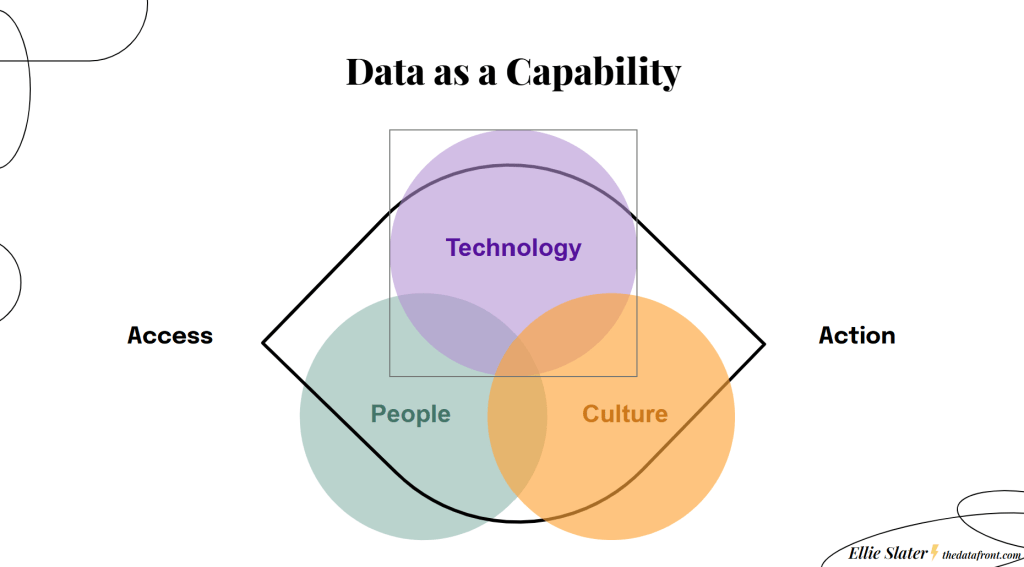
This is where I often talk about adoption as a capability, not a project. Tools enable it, but people and culture activate it.
From momentum to maturity
The final step is making adoption last. The strongest organisations do not treat adoption as a launch milestone, they treat it as an ongoing capability. They measure stories of value as much as usage stats. They reinforce good behaviour. They connect insight to outcomes so people understand why it matters.

I touched on these ideas in my session at Data Decoded MCR, and the conversations that followed showed just how widely these challenges are felt across industries.
If your team or Centre of Excellence is exploring similar questions, I’m always happy to share experiences and learn how others are approaching adoption in their own world. The more we compare across sectors, the easier it becomes to close the gap between access and action.
 The Data Front
Leave a comment